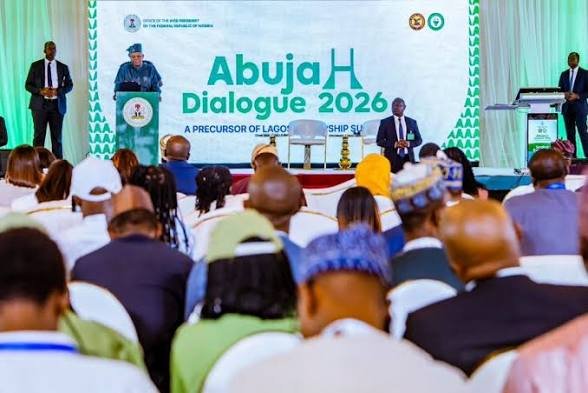
Vice-President Kashim Shettima has called for the establishment of a deliberate and institutionalised framework for youth leadership development, describing it as vital to Nigeria’s long-term stability and progress.

Shettima made the call on April 13, 2026, at the State House Banquet Hall during the Abuja Dialogue 2026, a high-level forum organised by the Office of the Vice President in collaboration with the Lateef Jakande Leadership Academy (LJLA).
Addressing participants, the vice-president cautioned that Nigeria’s demographic advantage as one of the world’s youngest nations would remain largely untapped without structured investment in leadership systems.
“We are one of the youngest nations on earth. That fact should not be treated as a line for conferences or a statistic for brochures. It is a national condition with profound consequences,” he said.
He stressed that leadership development must no longer be left to chance, noting that sustainable national growth depends on systems that prepare, integrate and support young people within governance and institutional frameworks.
According to him, youth leadership should be treated as “infrastructure” critical to governance, economic development and institutional resilience, rather than as a peripheral social intervention.
“Youth leadership must be understood with clarity. It is not a ceremonial handover waiting for age to perform its arithmetic. It is a structured process through which young men and women are prepared, trusted, integrated and supported,” he added.
Shettima also underscored the importance of accountability and gradual exposure to responsibility, noting that leadership matures through experience and disciplined engagement. He urged young Nigerians to approach leadership with a strong sense of duty, emphasising that competence, sacrifice and long-term thinking must define the next generation of leaders.
In his remarks, Babajide Olusola Sanwo-Olu, Governor of Lagos State, described the dialogue as a clear indication of federal commitment to youth development, stressing that leadership incubation must be supported by policy, funding and political will.
Sanwo-Olu highlighted the role of the Lateef Jakande Leadership Academy as a talent incubator offering public sector immersion, mentorship and cross-sector exposure for young Nigerians. He added that the initiative complements broader youth-focused programmes in Lagos, including the IBILE Youth Academy and the Lagos State Employment Trust Fund.
Also speaking, Deputy Chief of Staff to the President, Ibrahim Hassan Hadejia, said the dialogue reinforces the need to prioritise youth leadership as a deliberate national agenda rather than a symbolic effort.
Similarly, Minister of Youth Development Ayodele Olawande noted that Nigerian youths are prepared to contribute meaningfully to national development, adding that the Federal Government remains committed to creating enabling platforms for their participation.
In her remarks, Executive Secretary of the academy, Ayisat Agbaje-Okunade, said the dialogue seeks to reposition youth leadership from the margins of policy discussions to the centre of governance and development planning. She added that the initiative aims to build national consensus, align institutions and translate policy commitments into actionable programmes.
The Abuja Dialogue 2026, themed “Scaling Excellence: Youth Leadership as Strategic Infrastructure for National Transformation,” is positioned as a precursor to the Lagos Leadership Summit 2026 and is expected to drive coordinated and scalable approaches to leadership development across federal and state institutions.
The forum brought together policymakers, development partners and young leaders to explore how Nigeria can transition from isolated leadership successes to sustainable systems that outlive political cycles and individual tenures.