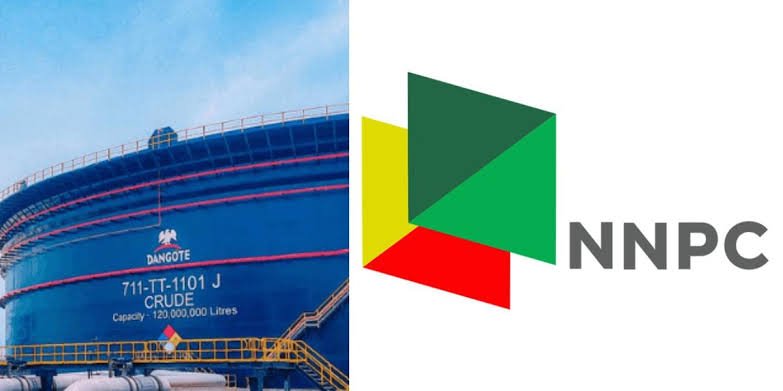
The Nigerian National Petroleum Company Limited (NNPC) has accused the Dangote Petroleum Refinery of attempting to monopolise Nigeria’s downstream petroleum market through its legal challenge against fuel import licences issued to rival marketers.

In a statement of defence filed before the Federal High Court in Lagos, NNPC argued that granting the reliefs sought by Dangote Refinery could expose Nigeria to fuel supply disruptions, price instability, and threats to national energy security.
The state oil company maintained that the Nigerian Midstream and Downstream Petroleum Regulatory Authority (NMDPRA) acted within its statutory powers in issuing fuel import licences.
According to NNPC, the law permits regulators to grant licences to companies with local refining capacity or proven experience in petroleum trading, while also allowing discretion under Nigeria’s backward integration policy.
The company further argued that there is no legal provision mandating a total ban on fuel imports except where there is a verified domestic supply shortfall.
NNPC rejected Dangote Refinery’s interpretation of the Petroleum Industry Act (PIA), insisting that fuel importation remains a legitimate mechanism for maintaining supply stability and controlling prices in the domestic market.
The dispute followed a suit filed by Dangote Refinery challenging the issuance and renewal of import licences granted to petroleum marketers and the NNPC.
The refinery is seeking an interim injunction restraining the Attorney-General of the Federation and relevant agencies from issuing or renewing licences for Premium Motor Spirit (PMS), Automotive Gas Oil (AGO), and Jet A1 fuel imports.
Dangote Refinery argued that continued approval of import licences undermines local refining efforts and violates Section 317(9) of the Petroleum Industry Act, which it interprets as restricting imports to situations where there is proven supply deficiency.
The refinery, with a refining capacity of approximately 650,000 barrels per day, maintained that Nigeria already has sufficient domestic refining output to meet local demand.
It cited regulatory figures indicating that daily petrol and diesel production currently exceeds national consumption levels, arguing that fuel imports are therefore unnecessary.
Dangote Refinery also told the court that it has the capacity to satisfy 100 per cent of Nigeria’s refined petroleum requirements while generating export surpluses.
The company described the refinery project as a major national investment capable of creating a multi-billion-dollar market for Nigerian crude oil.
However, NNPC disputed the refinery’s claims that it can independently guarantee national fuel supply, arguing that Dangote Refinery has not presented credible or verifiable evidence to support its production capacity assertions.
The NMDPRA has also applied to join the suit, widening the dispute into a broader regulatory and policy battle over fuel importation and market competition in Nigeria’s downstream oil sector.
Dangote Refinery further accused government agencies — including the NMDPRA, the Nigerian Upstream Petroleum Regulatory Commission (NUPRC), and the NNPC — of creating a hostile operating environment by continuing to issue import licences despite what it described as the absence of any supply gap.
The refinery also accused the NNPC of failing to provide sufficient crude oil for optimal operations, claiming it receives only about five crude cargoes monthly instead of the 13 needed to operate at full capacity, forcing it to source crude internationally at higher prices.
NNPC denied the allegation, insisting that crude allocation decisions are based on operational, commercial, security, and logistical considerations rather than any deliberate attempt to undermine refinery operations.
The dispute has assumed greater significance ahead of Dangote Refinery’s planned September initial public offering (IPO), with concerns emerging over regulatory certainty and market stability in Nigeria’s oil and gas sector.
While NNPC warned that restricting import licences could destabilise fuel supply and worsen price volatility in Africa’s largest oil market, Dangote Refinery argued that continued imports threaten its operations and Nigeria’s long-term ambition of achieving energy self-sufficiency.
The refinery is also seeking an interim injunction restraining the issuance of new import licences pending the determination of the substantive suit, arguing that it risks suffering irreparable financial and operational losses.
The court has yet to fix a date for hearing the matter.