


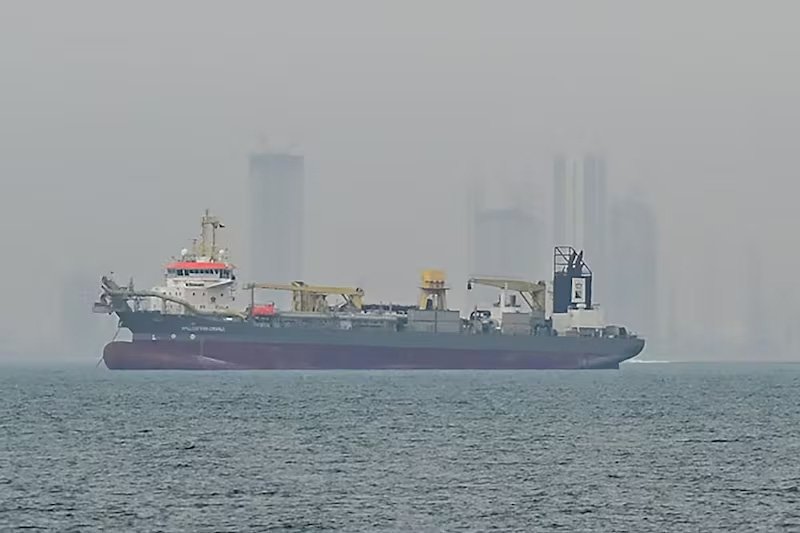
A vessel operated by a unit of the state-owned Abu Dhabi National Oil Company (ADNOC) has leaked fuel off the coast of Oman after being struck in a recent Iranian drone attack, raising fresh concerns over environmental and maritime security risks in the Gulf region.

ADNOC Logistics & Services confirmed on Wednesday that the tanker, identified as the M.V. Barakah, remained anchored off Oman’s coast after it was hit by two Iranian drones on May 4.
The company disclosed that the vessel had released what it described as a small quantity of bunker fuel into surrounding waters following the attack.
“The ADNOC Logistics & Services vessel Barakah is still anchored off Oman’s coast after being struck by two Iranian drones on May 4,” a company spokesperson said.
“A small quantity of what is believed to be bunker fuel was released as a result of the incident.”
The company did not specify the volume of the spill but confirmed that no crew members were injured and that the tanker was not carrying commercial cargo at the time of the attack.
The incident comes amid heightened regional instability and growing maritime security concerns around the Strait of Hormuz, one of the world’s most critical oil shipping routes.
Shipping activities across parts of the Gulf have reportedly faced increasing disruption and uncertainty in recent weeks due to tensions involving Iran.
Oman’s Maritime Security Centre had not issued an official statement on the spill as of Wednesday.
Satellite images captured by the European Union’s Copernicus Sentinel Programme earlier this month showed a visible white trail extending from the vessel near Oman’s Musandam Peninsula.
Analysts cited by TankersTrackers.com identified the source as the M.V. Barakah, while independent observers said the pattern appeared consistent with an oil-based discharge.
Louis Goddard, co-founder of consultancy firm Data Desk, said the trail “is definitely consistent with oil and is clearly coming out of the tanker.”
However, more recent satellite imagery reviewed by marine experts suggested the spill had largely dissipated.
Elizabeth C. Atwood of Plymouth Marine Laboratory told Reuters that the slick was no longer visible in updated satellite images.
In a separate incident last week, satellite monitoring reportedly detected another suspected large-scale oil slick near Kharg Island, a major Iranian oil export hub.
Iranian environmental authorities later suggested the spill may have resulted from wastewater discharge by a vessel rather than a leak from oil infrastructure facilities.
The latest incident has intensified concerns over maritime safety and environmental risks in one of the world’s most strategically important shipping corridors.