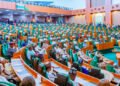


President Bola Tinubu has asked the National Assembly to consider and pass a fresh ₦43.56 trillion Appropriation (Repeal and Re-enactment) Bill for the 2024–2025 fiscal period, in a move aimed at ending the practice of running multiple budget cycles concurrently and strengthening accountability in public finance management.

In a letter to both chambers, the President said the proposed legislation would reset the federal budgeting framework, consolidate emergency expenditures undertaken in the national interest, and ensure what he described as “unprecedentedly high” capital performance for the 2024 and 2025 fiscal years.
A breakdown of the proposal shows that the bill seeks authorisation to draw ₦43,561,041,744,507 from the Consolidated Revenue Fund of the Federation. Of this amount, ₦1.74 trillion is earmarked for statutory transfers, ₦8.27 trillion for debt service, ₦11.27 trillion for recurrent (non-debt) expenditure, while ₦22.28 trillion is allocated to capital expenditure and development fund contributions—underscoring the administration’s renewed emphasis on infrastructure and growth-enhancing investments.
Tinubu explained that the reworked framework would provide an orderly and constitutionally grounded mechanism for consolidating critical, time-sensitive expenditures already incurred in response to emergency exigencies, including national security and citizens’ welfare. According to him, the initiative balances responsiveness to urgent needs with fiscal discipline, while closing loopholes that have historically undermined effective budget implementation.
The bill also embeds safeguards to tighten spending controls and enhance transparency. These include strict application of released funds to approved purposes, clear limits on virement without prior approval of the National Assembly, defined conditions for corrigenda, and separate recording of excess revenue with expenditure restricted to legislative approval. It further reinforces due-process compliance and mandates periodic reporting on fund releases, agency-generated revenues and external assistance.
The proposal is expected to face rigorous scrutiny amid mounting fiscal pressures, rising debt-service obligations and the government’s determination to accelerate capital spending as a catalyst for economic growth.
In the Senate, the bill was read at plenary and passed for second reading, after which it was referred to the Senate Committee on Appropriations for further work. The upper chamber also directed the Minister of Finance and Coordinating Minister of the Economy, Mr Olawale Edun; Minister of Budget and National Planning, Senator Atiku Bagudu; and FIRS Chairman, Dr Zacch Adedeji, among others, to appear before the committee to provide clarifications on the proposed expenditure plan.
Leading the debate, Senate Leader, Senator Opeyemi Bamidele, said the proposal was “not merely procedural, but structural and reform-driven,” explaining that it seeks “to repeal and re-enact the existing appropriation framework to bring an end to the unhealthy practice of running multiple budget cycles concurrently.” He said the practice had historically undermined budget clarity, weakened fiscal discipline and blurred accountability across MDAs.
Bamidele added that the bill provides a lawful mechanism to consolidate and regularise critical expenditures undertaken in response to emergency exigencies, describing it as a balance between responsiveness and responsibility. He noted that virement would only be permitted with prior legislative approval, adding that the provisions “collectively reaffirm the power of the purse vested in the legislature and ensure that executive flexibility does not translate into fiscal opacity or abuse.”
According to him, “They deepen trust in public finance administration and reassure Nigerians that every naira appropriated is traceable, justified, and lawfully spent. The repeal and re-enactment of the Appropriation Act, as proposed, therefore represents a necessary legislative intervention to consolidate past actions, clarify ambiguities, and provide a stronger statutory foundation for present and future budget implementation.”
Presiding, Deputy Senate President, Senator Barau Jibrin, referred the bill to the committee chaired by Senator Solomon Adeola, mandating it to report back within two days.
In the House of Representatives, Deputy Speaker, Hon. Benjamin Kalu, ruled that the President’s letter be taken as first reading and directed the Majority Leader to move the bill for second reading. The ruling drew objections from some lawmakers who demanded copies of the letter before further consideration. The bill was subsequently referred to the House Committee on Appropriations.
Separately, Tinubu is scheduled to present the 2026 Appropriation Bill to a joint session of the National Assembly on Friday. A statement by the Clerk to the National Assembly, Kamoru Ogunlana, signed by Essien Eyo Essien, said the presentation would take place at 2pm.
The Clerk directed all accredited persons to be at their duty posts by 11am, warning that latecomers would be denied access due to security arrangements, while non-accredited persons were advised to stay away from the complex. Staff, except designated principal officers, were also instructed to park at approved locations, stressing strict compliance with the directives.