

The President of the Dangote Group, Alhaji Aliko Dangote, has expressed strong doubts over the potential revival of Nigeria’s state-owned refineries, stating that despite billions of dollars in investments, the facilities have failed to function and may never do so.

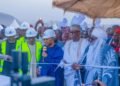
Speaking on Thursday while hosting members of Global CEO Africa from the Lagos Business School at the Dangote Petroleum Refinery in Lekki, Lagos, Dangote pointed to the persistent inefficiencies of the Nigerian National Petroleum Company Limited (NNPC)-managed Port Harcourt, Warri, and Kaduna refineries, which he said have consumed over $18 billion in turnaround maintenance costs without yielding results.
“I don’t think, and I doubt very much, if they will work,” Dangote declared.
He recounted the circumstances surrounding his earlier attempt to acquire the refineries during the administration of former President Olusegun Obasanjo, noting that the acquisition was later reversed by the government of late President Umar Yar’Adua.
“The refineries that we bought before, which were owned by Nigeria, were doing about 22 per cent of PMS. We bought the refineries in January 2007.
Then we had to return them to the government because there was a change of government,” he explained.
According to Dangote, the then-managing director of NNPC persuaded President Yar’Adua to revoke the sale, arguing that the facilities were undervalued and could be fixed internally.
“They said they just gave them to us as a parting gift or so. And as of today, they have spent about $18bn on those refineries, and they are still not working,” he added.
The billionaire industrialist likened the repeated rehabilitation efforts to attempting to modernise obsolete machinery:
“(The turnaround maintenance) is like you trying to modernise a car that was built 40 years ago, when technology and everything have changed. Even if you change the engine, the body will not be able to take the shock of that new technology engine,” he said.
Dangote also contrasted the performance of his Lekki-based 650,000 barrels-per-day refinery with the defunct government refineries. He noted that his facility currently dedicates over 50% of its output to Premium Motor Spirit (PMS), compared to the mere 22% committed by the NNPC refineries when operational.
His remarks reinforced earlier statements made by former President Olusegun Obasanjo, who in several public comments criticised the inefficiency and corruption surrounding Nigeria’s state-run refineries.
In a January interview, Obasanjo said:
“I was told not too long ago that since that time, more than $2bn have been squandered on the refineries and they still will not work. If a company like Shell tells me what they told me, I will believe them. If anybody tells you now that it (the refinery) is working, why are they now with Aliko (Dangote)? And Aliko will make his refinery work; not only make it work, he will make it deliver.”
Obasanjo also shared a conversation he had with Yar’Adua at the time of the sale reversal:
“I ran to him (Yar’Adua), I said, ‘You know this is not right’. He said, ‘Well, NNPC said they can do it.’ I said, ‘NNPC cannot do it.’ I told my successor that ‘the refineries, from what I heard and know, will not work and when you want to sell them, you will not get anybody to buy them at $200m as scrap’. And that is the situation we are in.”
Using a Yoruba proverb, the former president compared inflated performance claims to a farmer exaggerating his harvest:
“They say that after he has harvested 100 heaps of yams, he will also have
100 heaps of lies. You know what that means.”
Meanwhile, calls have intensified for the privatisation of the country’s aging refineries. The recent shutdown of the 60,000 barrels-per-day old Port Harcourt refinery—barely six months after being declared operational—has reignited concerns. The Warri refinery was similarly shut down one month after a relaunch by then-NNPC Group CEO, Mele Kyari.
The Manufacturers Association of Nigeria (MAN) has described the facilities as a financial burden and urged the government to sell them off. Crude refiners have also advised the government to sell the refineries as scrap and reinvest the proceeds into modular refining capacity.
Available data shows the Federal Government approved $1.4 billion for Port Harcourt’s rehabilitation in 2021, $897 million for Warri, and $586 million for Kaduna. In 2021 alone, ₦100 billion was reportedly spent on refinery rehabilitation, with a monthly expenditure of ₦8.33 billion. Between 2013 and 2017, $396.33 million was spent on turnaround maintenance—with no measurable output to date.
As of the time of filing this report, the NNPC could not be reached for comment. Although the company currently has no official spokesperson, messages sent to its listed contacts went unanswered.