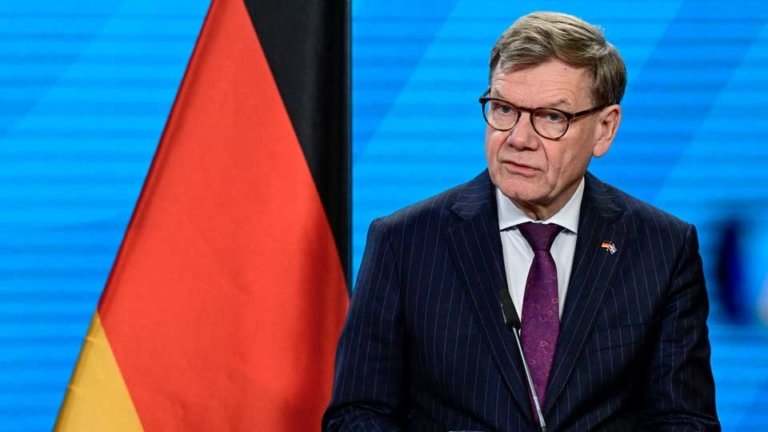
Germany’s Foreign Minister, Johann Wadephul, has described Nigeria as one of Europe’s most important suppliers of jet fuel, underscoring the country’s growing strategic role in Europe’s energy security while reaffirming Germany’s commitment to strengthening bilateral cooperation in trade, investment, security and renewable energy.

Wadephul made the remarks on Tuesday during a networking reception hosted by the German Embassy in Lagos as part of his official visit to Nigeria. The event brought together senior government officials, business leaders and members of a German business delegation to promote stronger political and economic ties between the two countries.
Speaking on the expanding energy partnership between Germany and Nigeria, the minister said recent developments have highlighted Nigeria’s increasing importance to Europe’s energy market.
“In the first half of 2026, Nigeria has become one of the most important jet fuel suppliers for Europe,” he said.
“Only in June, Nigeria covered 25 [per cent] of Europe’s jet fuel supplies. This is a vivid testimony of the importance of our partnership bilaterally and on global world trade.”
Wadephul said Germany remains committed to deepening its long-standing relationship with Nigeria, describing the country as one of Berlin’s most significant partners in Africa.
“We want to work together, Germany and Nigeria, Europe and Africa, striving for security, freedom and prosperity for our nations,” he said.
According to him, trade and investment continue to form the foundation of the bilateral relationship, noting that he travelled to Lagos with a delegation of German companies to explore new opportunities for economic cooperation.
The minister said German industries are prepared to support Nigeria’s energy transition by leveraging the country’s vast natural resources.
“German industry stands ready to support Nigeria in reducing its carbon footprint by unlocking this enormous potential using gas and oil.”
He added that both countries have broadened their energy partnership to include climate dialogue and renewable energy initiatives.
Wadephul also commended Nigeria’s contributions to regional peace and security, particularly in the Gulf of Guinea and the Lake Chad Basin, revealing that Germany has provided military instructors, equipment and about $120 million in support for security initiatives.
Beyond security and energy, he said cooperation between both countries has expanded to education, research and cultural exchange, noting that there are now more than 50 university partnerships between Germany and Nigeria, while the number of Nigerian students studying in Germany has quadrupled over the past decade.
Highlighting Nigeria’s rapidly growing technology ecosystem, the minister said the country’s youthful and innovative workforce presents significant opportunities for deeper collaboration.
“I believe there is a tremendous potential for expanding our partnership when Europe’s largest economy and Africa’s most populous nation and economic powerhouse come together. Good things can happen, provided we stand together and work together,” he said.
The reception concluded with a networking session involving members of the German delegation, Nigerian government officials, investors and business executives, who explored opportunities to expand cooperation in energy, infrastructure, technology, education and trade.