The National Assembly has approved President Bola Tinubu’s request to implement a new external borrowing plan totaling $2.347 billion as contained in the 2025 Appropriation Act.

The approved plan includes external borrowings of up to $2.347 billion, part of which will be used to refinance maturing Eurobonds. Lawmakers also approved the issuance of Nigeria’s first-ever sovereign Sukuk in the international capital market, valued at $500 million, to fund key infrastructural projects.
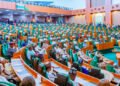
The Senate’s resolution followed the adoption of the report of its Committee on Local and Foreign Debts, presented by its Chairman, Senator Aliyu Wamakko. The House of Representatives likewise adopted the report of its Committee on Loans and Debt, presented by its Chairman, Hassan Nalaraba.
The borrowing request, first read in the Senate on October 8, 2025, sought legislative approval for new external loans and debt refinancing measures in line with the 2025 fiscal framework.
Chairman of the Senate Committee on Finance, Senator Mohammed Sani Musa, urged his colleagues to support the request, describing it as crucial for funding the 2025 budget.
“It is very needful that we give approval to this request so that the 2025 appropriation will be given the necessary funding,” Musa said.
Similarly, Chairman of the Senate Committee on Banking, Senator Adetokunbo Abiru, said the request was in line with established fiscal compliance measures.
“This is more of a compliance issue because the 2025 Appropriation Act has already captured it as part of the deficit financing,” Abiru noted. “The second request is a refinancing to ensure that the country doesn’t default in Eurobond servicing.”
Also contributing, Senator Adams Oshiomhole reiterated that borrowing was acceptable if it targeted job creation and infrastructure development.
In a breakdown, the House of Representatives approved the implementation of a new external borrowing of ₦1.84 trillion (about $1.229 billion at the budget exchange rate of $1/N1,500) to partially finance the ₦9.28 trillion budget deficit. The House also endorsed the refinancing of a $1.118 billion Eurobond maturing on November 21, 2025, at a coupon rate of 7.625 percent.
The government is expected to raise the funds through any combination of eurobond issuances, loan syndications, bridge finance facilities, or direct borrowing from international financial institutions.
President Tinubu’s letter to the National Assembly, dated September 22, 2025, and read in plenary on October 7, sought resolutions under Sections 21(1) and 27(1) of the Debt Management Office (Establishment, Etc.) Act, 2003, to facilitate the borrowing and refinancing plans.
“The purpose of the request is to implement the new external borrowing in the 2025 Appropriation Act, refinance maturing Eurobonds, and issue a debut sovereign Sukuk in the international market,” the President stated.
Tinubu explained that the planned borrowing would comprise $1.229 billion in new loans and $1.118 billion for Eurobond refinancing, totaling $2.347 billion. The funds are to be sourced through any of the following channels: issuance of Eurobonds, loan syndications, bridge finance facilities, or direct borrowings from international institutions.
He further noted that Nigeria, as a regular issuer of Eurobonds in the international capital market, could successfully raise the proposed amount subject to prevailing market conditions.
“The Federal Ministry of Finance and the Debt Management Office will work with transaction advisers to secure the most favourable terms and conditions,” the President said.
Tinubu also sought approval for the issuance of a stand-alone debut Sovereign Sukuk of up to $500 million in the international market, with or without credit enhancement from the Islamic Corporation for the Insurance of Investment and Export Credit (ICIEC), a member of the Islamic Development Bank Group.
He highlighted the success of previous domestic Sukuk issuances, through which the Debt Management Office raised ₦1.39 trillion between 2017 and 2025 for critical road infrastructure.
“There is the need to pool resources from external sources to complement domestic issuance and help bridge infrastructure funding gaps,” Tinubu said. “It is imperative to open new sources of funding for the Federal Government and thereby diversify the investor base and deepen the FGN securities market.”
The President added that if the ICIEC guarantee is utilized, “25 percent of the issue proceeds may be used to repay relatively more expensive debt obligations of the Federal Government, while the balance will finance pre-identified infrastructure projects.”
He concluded by urging lawmakers to pass the resolution authorizing the federal government to raise the external capital of $2.347 billion, comprising new external borrowing and Eurobond refinancing, and to issue the debut $500 million Sovereign Sukuk.