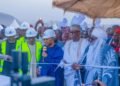
President and Chief Executive of Dangote Group, Aliko Dangote, has led the groundbreaking of a $2.5 billion fertiliser plant in Gode, Ethiopia — a landmark partnership between Dangote Group and Ethiopian Investment Holdings (EIH) aimed at transforming the country’s agricultural and industrial landscape.

According to a statement by the company, the plant — with a production capacity of three million metric tonnes of urea annually — will be one of the largest fertiliser complexes in the world. Strategically located in Ethiopia’s southeast region, it will leverage the country’s natural gas reserves in Hilal and Calub to enhance agricultural productivity, create jobs, and strengthen food security across the Horn of Africa.
Speaking at the ceremony, Prime Minister Abiy Ahmed described the project as a milestone in Ethiopia’s economic development and regional cooperation.
“They embody our shared responsibility to harness opportunities, strengthen cooperation, and promote peace,” Abiy said.
“By doing so, we elevate Ethiopia’s presence on the global stage in a way that honours the true spirit of our Ethiopian identity.”
Dangote praised the Prime Minister and his cabinet for the government’s reform agenda and economic liberalisation policies, which he said have made Ethiopia one of Africa’s most attractive destinations for investors.
“This partnership with Ethiopian Investment Holdings represents a pivotal moment in our shared vision to industrialise Africa and achieve food security across the continent,” Dangote stated.
“We are committed to bringing our decades of experience in large-scale industrial projects to ensure this venture becomes a cornerstone of Ethiopia’s industrial transformation.”
The billionaire industrialist disclosed that the Gode fertiliser project is only the beginning of broader plans to expand into the production of ammonium nitrate, ammonium sulphate, NPK, and calcium ammonium nitrate, positioning Ethiopia as a regional fertiliser hub.
Dangote predicted that with such investments, Ethiopia could become Africa’s leading agricultural nation within five years.
He also noted that the new venture marks the first time a private African investor is partnering with an African nation to develop an industrial complex of this scale.
“We understand Africa—its challenges, its opportunities, and its potential. And we believe only Africans can truly transform Africa,” he said.
“Our mission at Dangote Group is to lead Africa’s industrial transformation.”
The Gode project is Dangote Group’s second major investment in Ethiopia. Its cement subsidiary currently operates a 2.5 million tonnes-per-annum plant in Mugher, with an additional $400 million investment to double capacity.
Dangote said the Group’s continental strategy is guided by the belief that “only Africans can develop Africa.” He highlighted how the company’s ventures in Nigeria had turned the country from an import-dependent economy to an exporter of cement, fertiliser, and soon, petroleum products.
“We’ve moved from being import-dependent to becoming self-sufficient and even exporters. Our mission is to help other African nations achieve the same transformation,” he said.
Dangote also revealed plans to establish a polypropylene bagging plant in Ethiopia to support the fertiliser industry.
He expressed appreciation to financial partners including Afreximbank, Africa Finance Corporation, Access Bank, First Bank, Zenith Bank, and other indigenous institutions for supporting the project.
President of the Somali Region, Mustafa Omar, hailed Dangote as “the anchor investor Ethiopia has been looking for,” describing him as a trusted partner “highly appreciated by both Ethiopians and Africans at large.”
Also speaking, Chairman of the Nigerian Exchange Group (NGX), Dr. Umaru Kwairanga, lauded Ethiopia’s leadership for its bold economic reforms and described the fertiliser complex as a “gigantic project befitting of Aliko Dangote’s vision and execution capacity.”
He added that Dangote’s consistency in driving Africa’s self-sufficiency and industrial growth remains “a source of continental pride.”
The groundbreaking ceremony was attended by senior Ethiopian government officials, industry leaders, and international financiers, signalling a new chapter in Nigeria–Ethiopia economic cooperation and a major boost for Africa’s agricultural industrialisation.