

Prime Minister Sir Keir Starmer has reaffirmed that the UK will not be forced to choose between strengthening ties with the United States or the European Union, following President Donald Trump’s threat of trade tariffs on the EU.

Speaking after a high-level meeting in Brussels, Starmer emphasized the UK’s commitment to maintaining strong relationships with both the US and the EU.
“Now, that for me isn’t new. I think that’s always been the case and will be the case for many, many years to come,” he stated when asked whether he would compromise closer UK-EU ties to maintain good standing with the US.
Trade and Tariff Concerns
Over the weekend, Trump announced 25% tariffs on Canada and Mexico—later paused—and suggested similar action against the EU while implying that a deal with the UK could be worked out. Discussions regarding trade tariffs with the US are still in their “early days,” Starmer noted, adding that he supports “open and strong trading relations.”
His visit to Brussels, where he met with NATO Secretary General Mark Rutte and EU leaders, marks the first time a UK prime minister has attended such talks since Brexit.
NATO, Defence Spending, and Military Cooperation
While trade remains a critical issue, Starmer’s trip was primarily focused on defence. Addressing the European Council, he advocated for deeper UK-EU military cooperation, including improved logistics, research and development, and protection against state threats such as subsea infrastructure sabotage.
Rutte acknowledged tensions between the US and the EU but stressed that such issues “will not get in the way of our collective determination to keep our deterrent strong.”
On Ukraine, he called for continued military support to ensure Kyiv negotiates with Russia “from a position of strength.” He also urged NATO members to increase defence spending, stating that the current 2% GDP target was “not enough to keep us safe.”
The UK currently spends 2.3% of GDP on defence, and Starmer confirmed his government would soon outline a roadmap to reach 2.5%.
Balancing UK-US-EU Relations
The UK’s evolving position between Washington and Brussels raises questions about its trade strategy. While Downing Street insists on maintaining “a fair and balanced trading relationship” with the US—valued at £300 billion—closer UK-EU ties could complicate negotiations with Washington.
Reform UK leader Nigel Farage accused Starmer of being “a rejoiner at heart,” arguing that deepening industrial collaboration with the EU could limit UK flexibility in striking trade deals with the US.
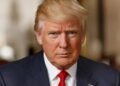
Trump, when asked if the UK could also face tariffs, responded: “UK is out of line, but I think that one can be worked out.” He described his interactions with Starmer as “very nice,” citing “numerous phone calls and meetings.”
Growing Concerns Over Global Trade War
Trump’s tariff threats have already rattled global markets, particularly impacting European and Asian car manufacturers. A University of Sussex study estimated that the UK could face a £22 billion hit to exports if the US imposed a blanket 20% tariff on all imports.
Meanwhile, European leaders have signaled their readiness to retaliate. European Commission President Ursula von der Leyen stated that while the EU seeks a “constructive dialogue,” it will respond “firmly” to unfair trade measures. French President Emmanuel Macron warned that if European interests were targeted, the EU would “have to make itself respected and react.”
EU foreign policy chief Kaja Kallas noted that “there are no winners in trade wars,” adding that if tensions escalate between the US and the EU, “the one laughing on the side is China.”
Future of UK-EU Trade Relations
While defence was a key focus of Starmer’s Brussels trip, his government is also exploring ways to ease restrictions on food and animal product trade with the EU, align emission trading schemes, and improve cross-border movement for professionals and musicians.
The EU, in turn, is pushing for a youth mobility scheme to allow young people from both sides to work and study more freely—an idea the UK has so far resisted.
Downing Street has not ruled out joining the Pan-Euro-Mediterranean Convention, which would enable tariff-free trade on certain goods. However, opposition parties remain divided.
Liberal Democrat leader Sir Ed Davey has urged the government to negotiate a new UK-EU customs union, arguing that Trump is “acting like a playground bully” and that Britain should work with its Commonwealth and European allies to counter US trade threats.
The Conservative Party, on the other hand, has accused Starmer’s government of “trying to reopen the divisions of the past and edge us back into the EU.”
As the UK navigates its post-Brexit position, Starmer faces the delicate challenge of balancing strategic alliances with both Washington and Brussels—without being drawn into an escalating trade war.