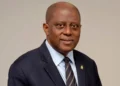
The Chairman of the Presidential Committee on Fiscal Policy and Tax Reforms, Taiwo Oyedele, has expressed concern over the potential global trade disruptions stemming from the establishment of the External Revenue Service, recently announced by U.S. President Donald Trump.

In a statement shared via his X handle on Monday night, Oyedele responded to Trump’s inauguration speech, during which the U.S. president unveiled his plan for the External Revenue Service. Trump stated, “Instead of taxing our citizens to enrich other countries, we tariff and tax other countries to enrich our citizens. For this purpose, we are establishing the External Revenue Service to collect all tariffs, duties, and revenue. It will be a massive amount of money pouring into our treasury coming from far.”
Reacting to the announcement, Oyedele noted, “The 47th President of the United States, Donald J. Trump, announced plans to establish an External Revenue Service to impose tariffs and taxes on other countries. This move could disrupt international trade and further complicate the already complex global tax system, highlighting the importance of our ongoing tax reforms.”
He emphasized the need for Nigeria to strengthen its tax framework in light of this development. “By revamping Nigeria’s tax system, we can better navigate potential challenges and seize any opportunities this development may present,” Oyedele added.
Oyedele, who leads the ongoing tax reform efforts in Nigeria, has been instrumental in advancing several legislative initiatives. On October 3, 2024, President Bola Tinubu submitted four tax reform bills to the National Assembly: the Nigeria Tax Bill, the Nigeria Tax Administration Bill, the Nigeria Revenue Service Establishment Bill, and the Joint Revenue Board Establishment Bill. These bills have sparked debates on equity, implementation, and their broader economic implications.
The Nigerian Governors’ Forum (NGF) recently endorsed a revised Value Added Tax (VAT) sharing formula, aiming to promote equitable resource distribution among states. The proposed formula allocates 50% based on equality, 30% based on derivation, and 20% based on population. Oyedele has publicly supported this proposal, describing it as a step toward fairness in resource allocation.
Speaking at The Platform, an event hosted by The Covenant Nation on Saturday, Oyedele highlighted the importance of a gradual approach to implementing reforms. “You also need to consider other things, including political considerations. At the end of the day, if you need to move one kilometre, you don’t have to move all of that at once; you can’t even jump one kilometre at once. Maybe sometimes you need to just move gradually,” he said.
As the global economic landscape evolves, Nigeria’s tax reform efforts remain pivotal in navigating potential challenges while ensuring fiscal sustainability.