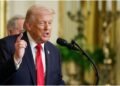
US President Donald Trump on Tuesday delivered a firm defence of Saudi Crown Prince Mohammed bin Salman, insisting the kingdom’s de facto leader had no knowledge of the 2018 murder of journalist Jamal Khashoggi—a stance that contradicts long-standing US intelligence conclusions.

Trump made the comments during bin Salman’s first visit to the White House in more than seven years, a high-stakes trip aimed at reinforcing security and economic ties while helping rehabilitate the crown prince’s image, which remains tarnished by the Khashoggi killing.
US intelligence agencies had previously determined that bin Salman approved the operation to capture or kill Khashoggi, a Washington Post columnist and outspoken critic of the Saudi government, who was murdered inside the Saudi consulate in Istanbul. Although the crown prince has denied ordering the killing, he has accepted responsibility as the kingdom’s ruler.
Seated beside bin Salman in the Oval Office, Trump dismissed the intelligence findings.
“A lot of people didn’t like that gentleman… things happened, but he knew nothing about it, and we can leave it at that,” he told reporters, after expressing irritation at the question.
Bin Salman described the murder as “painful,” adding that his government had taken “all the right steps of investigation” and strengthened safeguards to prevent a repeat. “It’s a huge mistake,” he said.
Trump’s remarks drew swift criticism from Khashoggi’s widow, Hanan Elatr Khashoggi, who told Reuters that “nothing can justify such a horrible crime,” urging Trump to meet her to understand “the real Jamal.”
Despite the controversy, the meeting underscored a milestone in US-Saudi relations. Trump announced he was designating Saudi Arabia as a major non-NATO ally, paving the way for expanded military and economic cooperation. Both governments also unveiled agreements spanning arms sales, civil nuclear development, artificial intelligence and critical minerals.
According to a White House fact sheet, Washington and Riyadh concluded a Strategic Defense Agreement aimed at strengthening deterrence across the Middle East and facilitating operations for US defence companies in the kingdom. The arrangement includes new burden-sharing contributions from Saudi Arabia, though it falls short of the treaty-level pact Riyadh originally sought.
The US has also approved future deliveries of F-35 fighter jets to Saudi Arabia, alongside Riyadh’s plan to purchase 300 American tanks. If finalised, it would mark the first F-35 sale to the kingdom—an outcome expected to reshape the region’s military balance and test Washington’s pledge to preserve Israel’s qualitative military edge.
The two governments further announced the completion of negotiations on civil nuclear cooperation, establishing a legal framework for long-term collaboration. However, progress remains uncertain as Saudi Arabia resists US restrictions on uranium enrichment and fuel reprocessing.
Bin Salman’s visit began with a full ceremonial welcome on the South Lawn, complete with military honours, a cannon salute and a flyover by US warplanes. During the Oval Office appearance, he pledged to raise Saudi investment in the United States to $1 trillion, up from an earlier $600 billion commitment, though he offered no timeline or details.
Saudi Arabia also signed agreements on artificial intelligence and critical minerals, aligning with the crown prince’s Vision 2030 initiative to diversify the economy beyond oil. Analysts, however, caution that a trillion-dollar investment may prove challenging given the massive capital demands of Riyadh’s domestic megaprojects.
Bin Salman is expected to promote these reforms at an investment summit at the Kennedy Center, where leading global executives are scheduled to attend.
Trump, meanwhile, dismissed suggestions that his personal business interests influenced his decision-making on Saudi Arabia.
“I have nothing to do with the family business,” he said, explaining that his assets are held in a trust managed by his children. He remains the trust’s beneficiary and will regain full access to profits once out of office.