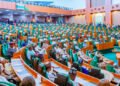
The Nigerian Senate on Tuesday, December 2024, passed the 2025-2027 Medium Term Expenditure Framework (MTEF) and Fiscal Strategy Paper (FSP).

The approved framework sets the foundation for the nation’s fiscal policies and budgetary allocations over the next three years.
During plenary, the Senate considered a report presented by Senator Sani Musa, Chairman of the Senate Committee on Finance.
Following deliberations, the lawmakers endorsed a total spending plan of ₦47.9 trillion for 2025, including a borrowing plan of ₦9.22 trillion, encompassing both domestic and foreign debt.
The MTEF/FSP provides a three-year spending projection for the federal government, serving as the basis for the annual budget.
The Senate approved key benchmarks, including an exchange rate of ₦1,400 to a dollar and oil price projections of $75 per barrel for 2025, $76.2 for 2026, and $75.3 for 2027.
Oil production targets were set at 2.06 million barrels per day in 2025, 2.10 million in 2026, and 2.35 million in 2027.
The lawmakers also endorsed a fiscal deficit of ₦13.08 trillion and allocated ₦15.38 trillion for debt servicing.
Pensions, gratuities, and retirees’ benefits were assigned ₦1.443 trillion. Capital expenditure was projected at ₦16.48 trillion, while statutory transfers were set at ₦4.26 trillion.
The sinking fund allocation stood at ₦430.27 billion, and recurrent non-debt expenditure was pegged at ₦14.21 trillion.
The Senate further approved GDP growth projections of 4.6% in 2025, 4.4% in 2026, and 5.5% in 2027, emphasizing the framework’s focus on sustained economic growth.
The passage of the MTEF/FSP marks a critical step in Nigeria’s fiscal planning process, providing the foundation for the forthcoming national budget.