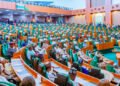
The Nigerian Senate on Tuesday approved the 2026–2028 Medium-Term Expenditure Framework and Fiscal Strategy Paper (MTEF/FSP), clearing a major procedural step ahead of the presentation of the 2026 Appropriation Bill to the National Assembly.

Under the approved framework, federal government spending for the 2026 fiscal year was set at ₦54.46 trillion, with benchmarks and macroeconomic projections designed to strengthen fiscal discipline and cushion the economy against global economic shocks.
In adopting the report presented by the Chairman of the Senate Committee on Finance, Senator Sani Musa, lawmakers endorsed key assumptions, including maintaining crude oil production at 1.84 million barrels per day (mbpd) for 2026 and pegging the exchange rate at ₦1,512 to the U.S. dollar. The framework projects real GDP growth of 4.68 per cent for 2026, rising in subsequent years.
A significant adjustment approved by the Senate was the reduction of the crude oil price benchmark for 2026 from the executive’s proposal to $60 per barrel, reflecting caution amid persistent global market volatility. The benchmarks for 2027 and 2028 were set at $65 and $70 per barrel, respectively.
On the fiscal aggregates, the framework anticipates ₦34.33 trillion in retained government revenue alongside ₦17.88 trillion in new borrowings, covering both domestic and foreign sources. Debt servicing costs were projected at ₦15.52 trillion, with capital expenditure earmarked at ₦20.131 trillion.
“The medium-term expenditure framework is only a prerequisite before the presentation of the budget … If circumstances change, it will be brought back to us for adjustments,” Senate President Godswill Akpabio said, underscoring that the framework does not represent the legislature’s final position on the budget.
Several senators welcomed the approved parameters, describing them as “realistic and achievable” in light of current economic conditions. Provisions to enhance revenue generation—including implementation of new tax laws and a national scanning policy under the Nigeria Customs Service and Nigeria Revenue Service’s single window—were also highlighted as measures to improve fiscal performance.
With the MTEF/FSP now adopted, the National Assembly expects to receive the 2026 budget proposal later this week, marking the formal commencement of Nigeria’s fiscal year planning cycle.