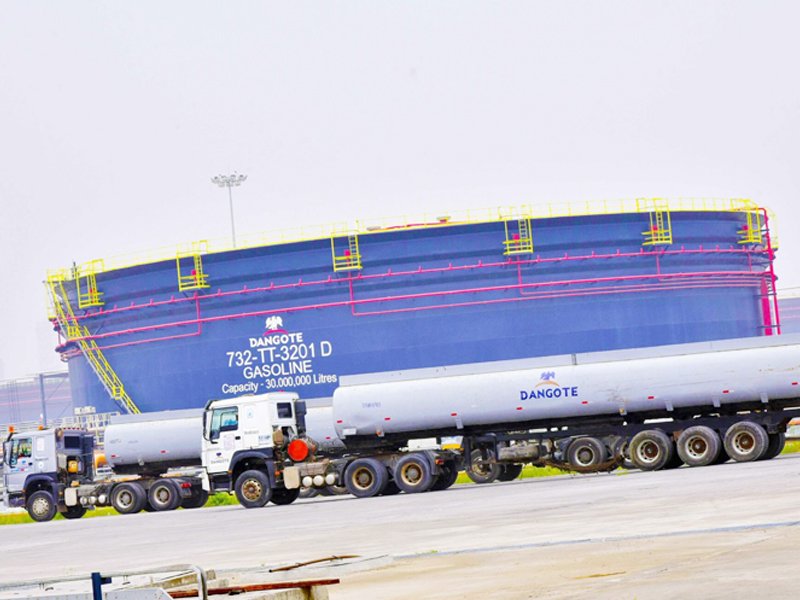
The Dangote Refinery and Petrochemicals is set to launch its fleet of Compressed Natural Gas (CNG)-powered trucks today as it commences the nationwide distribution of Premium Motor Spirit (PMS).

The refinery had announced in August that it received the first batch of its 4,000 CNG-powered trucks, earmarked for its direct fuel distribution programme, which was initially scheduled to begin on August 15.
Speaking during a courtesy visit by the AfricaRice Centre to his Lagos office on Sunday, the President of the Dangote Group, Aliko Dangote, said the decision to adopt direct fuel distribution was aimed at reducing dependency on third-party carriers for fuel transportation across Nigeria.
According to him, the move is not just a strategic choice but a national imperative.
Last week, the Depot and Petroleum Products Marketers Association of Nigeria (DAPPMAN) had accused the refinery of “offering lower prices to international buyers while quoting higher rates to local off-takers.”
The association, while welcoming the refinery’s operations, noted that the facility currently contributes between 30 to 35 per cent of the nation’s fuel demand.
They also alleged that the refinery does not provide free product delivery to buyers and claimed that its constant price cuts, alongside plans to bypass existing distributors, were “not patriotic” but rather “a business move intended to monopolise the downstream market.”
Responding to the allegations, Dangote explained that the refinery opted against using the Single Point Mooring (SPM) system to avoid an additional N75 per litre in handling charges, which he said would translate to about N1.5 trillion annually.
The SPM system is an offshore loading buoy used as a connection point for tankers to load or unload petroleum products.
“If the Dangote Refinery were to load 40 million litres of PMS and 15 million litres of AGO (diesel) via the Single Point Mooring (SPM) at an extra cost of N75 per litre in handling charges, it would amount to approximately N1.5 trillion annually in avoidable charges.
“By contrast, utilising gantry loading and direct trucking would eliminate these costs entirely, resulting in substantial savings that could be redirected towards critical infrastructure investments.
“Losing N75 per litre to intermediaries who cannot guarantee that the products will be delivered to the Nigerian consumer is not a viable option. Rather than enabling such exploitation, we are committed to partnering with credible distributors and expanding humanitarian outreach, ensuring that petroleum products get to the Nigerian people transparently and affordably,” Dangote said.
The 4,000 CNG trucks, representing an investment of over N720 billion, form a key part of the refinery’s new distribution model. The initiative, which began in August 2025, is expected to significantly lower logistics costs, reduce the environmental impact of fuel transportation, and support over 42 million micro, small, and medium enterprises (MSMEs) by lowering energy costs.
The trucks, which will transport refined products directly from the refinery, are powered by CNG supplied by local partner Tetracore Energy Group.