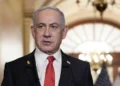
Israel has launched a large-scale military offensive against Iran, targeting nuclear sites and senior military leaders in what Prime Minister Benjamin Netanyahu described as a multi-day campaign. The Israeli military confirmed it deployed 200 fighter jets in the unprecedented operation.

In response, Iran fired more than 100 drones toward Israeli territory, according to Israel’s military, signaling a rapid escalation between the longtime adversaries.
Among those killed in the Israeli strikes were two of Iran’s most influential military figures—General Hossein Salami, commander-in-chief of the Islamic Revolutionary Guard Corps (IRGC), and Major General Mohammad Bagheri, Iran’s highest-ranking military officer. Their deaths mark a significant blow to Iran’s defense structure.
Prime Minister Netanyahu said the operation, dubbed “Operation Rising Lion,” targeted Iran’s main uranium enrichment site at Natanz, several nuclear scientists, and what he called “the heart of Iran’s ballistic missile program.” Iranian state-affiliated Tasnim News Agency reported that six nuclear scientists were among the dead.
U.S. Secretary of State Marco Rubio stated unequivocally that the United States had no role in or prior knowledge of the strikes. He emphasized that the operation was carried out independently by Israel. Before the attack, former U.S. President Donald Trump had expressed opposition to any Israeli strike on Iran, citing ongoing negotiations aimed at reviving the nuclear deal.
Several Arab nations have issued strong condemnations of Israel’s actions, underscoring regional efforts to de-escalate and avoid being drawn into the conflict. The statements suggest a unified stance among Middle Eastern countries to distance themselves from the growing hostilities between Israel and Iran.
As tensions soar, the international community watches closely, with fears of a broader conflict now looming over the region.