Gov. Dauda Lawal has launched Zamfara State’s Homegrown School Feeding Programme, a major initiative aimed at tackling the high number of out-of-school children by improving enrollment, retention, and completion rates across public primary schools.

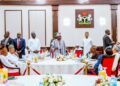
The official flag-off ceremony took place at Dan-Turai Primary School in Gusau, where the governor joined pupils in a symbolic shared meal—demonstrating the state’s renewed commitment to accessible and inclusive education for all.
Speaking at the event, Governor Lawal described the initiative as part of an emergency response to address deep-rooted challenges in the state’s education sector. “This school feeding programme is designed not only to fight hunger and malnutrition among our children but also to boost enrollment and ensure that every child has the opportunity to complete basic education,” he said.
He added that the government is working closely with development partners such as the World Bank, UNICEF, the International Center for Economic Development (ICED), and the FINPACT Development Foundation (FINDEF) to strengthen educational outcomes in Zamfara.
“Our commitment to reform includes partnerships that will help us bring out-of-school children back to classrooms,” Lawal said. “A technical committee is already working across the 14 LGAs to identify these children and facilitate their return.”
The pilot phase of the programme targets over 4,000 pupils across five local government areas—Gusau, Talata Mafara, Anka, Maru, and Shinkafi. FINDEF is sponsoring meals for 1,000 pupils across four LGAs, while ICED is supporting feeding for 3,300 pupils in three LGAs.
The Commissioner for Education, Wadatau Madawaki, and the Commissioner for Humanitarian Affairs, Salisu Musa, praised the initiative as a timely intervention in the fight against child hunger and school dropout.
They also commended development partners for supporting the pilot rollout.
Zamfara remains one of Nigeria’s most educationally challenged states, with thousands of children—especially in rural areas—unable to access or complete basic education due to poverty, insecurity, and lack of support systems. Governor Lawal’s school feeding programme seeks to reverse that trend and reposition education as a tool for empowerment and long-term development.