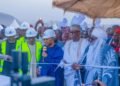
The Minister of State for Defence, Bello Matawalle, has reaffirmed the commitment of the Defence Industries Corporation of Nigeria (DICON) to fulfilling the operational needs of the military and other security agencies.

Speaking at DICON’s end-of-year celebration and Director-General’s Productivity Award ceremony on Friday in Kaduna, Matawalle highlighted the impact of the recently enacted DICON Act 2023, signed into law by President Bola Tinubu. He described the legislation as a game-changer that would bolster Nigeria’s defence capabilities and reduce dependence on foreign military procurements.
“The Defence Ministry has given the DICON Director-General numerous tasks, and I can assure you that he is more than capable of delivering,” Matawalle stated.
He expressed optimism that within a short time, Nigeria would celebrate the full-scale production of arms within the country, as part of efforts to curtail excessive reliance on imports.
DICON to Prioritise Local Military Production
The minister emphasized the federal government’s resolve to limit external military procurements, noting that the newly enacted DICON Act is already making significant strides in this direction.
“Any requirements of the military or other security agencies have to come to DICON for supply,” Matawalle said.
He lamented Nigeria’s previous practice of spending huge sums abroad on military equipment, which, he said, contributed to currency devaluation.
“Before now, we sent our money to other countries, devaluing our currency and driving up the dollar because we didn’t have a solid productivity plan. Today, thanks to the leadership of DICON’s Director-General, the industry is witnessing remarkable progress,” he added.
Matawalle disclosed that DICON was now meeting the demands of the military and paramilitary forces, particularly in the production of arms and ammunition.
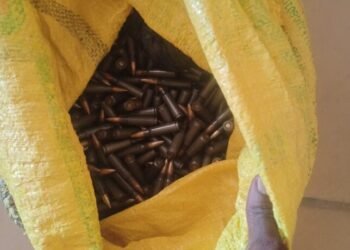
“I never believed DICON could produce 10,000 rounds of ammunition, but today, it has exceeded that expectation. Our target is 300 million rounds, alongside other military hardware like Mine-Resistant Ambush-Protected (MRAP) vehicles, Unmanned Aerial Vehicles (UAVs), and other advanced defence equipment,” he revealed.
He assured Nigerians that within the next three to four months, DICON would fully meet the supply demands of the armed forces and security agencies.
DICON’s Commitment to Technological Advancement
Earlier, DICON’s Director-General, Maj.-Gen. Anaedi Edet, underscored the corporation’s mission to ensure Nigeria’s self-reliance in military hardware.
“DICON was established with a visionary mandate to enhance the operational capabilities of the Nigerian Armed Forces and foster technological advancement within the country,” he noted.
Edet recalled that while DICON initially focused on small arms and ammunition, the corporation had expanded its scope to address contemporary security challenges and even ventured into civilian applications.
Despite recorded successes, he acknowledged that funding constraints, outdated equipment, skill gaps, and the need for staff training remain critical challenges.
“We are determined to overcome these obstacles. Our focus remains on securing new funding opportunities, modernizing our production lines, and prioritizing workforce development,” Edet assured.
He also reiterated DICON’s commitment to its ‘All DICON Factories Must Produce’ initiative, aimed at enhancing technological innovation and collaboration for national security and prosperity.
The event, he noted, was not just a celebration of achievements but also an opportunity to recognize outstanding employees whose contributions have driven DICON’s progress in 2024.
“DICON remains unwavering in its mission to build a self-sufficient defence industry that meets the security needs of the nation,” Edet concluded.