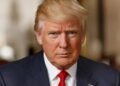


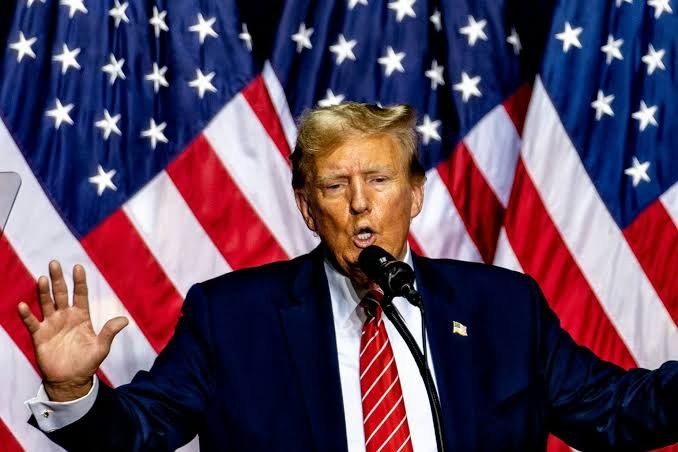
Former United States President Donald Trump has criticised Iran’s decision to appoint Mojtaba Khamenei as the country’s new supreme leader, describing the move as a serious error.
“I think they (Iran) made a big mistake” in selecting Mojtaba Khamenei, Trump told NBC News.

Trump had earlier dismissed the new Iranian leader as a “light weight” and said it was “too soon to talk about” the possibility of seizing Iran’s oil resources, although he added that he “doesn’t rule it out.”
Speaking on Monday at a gathering of congressional Republicans at his golf club in Doral, Florida, Trump also described the ongoing conflict with Iran as a limited engagement.
“We took a little excursion because we felt we had to do that to get rid of some people. And I think you’ll see it’s going to be a short-term excursion,” he said.
Despite expressing confidence about progress in the conflict, the 79-year-old former president insisted that the United States and Israel still had more to accomplish.
“We’ve already won in many ways, but we haven’t won enough,” Trump said, calling for “ultimate victory” against Iran.
Referring to the killing of Iran’s former supreme leader, Ali Khamenei, and other senior Iranian figures, Trump added that the United States “will not relent until the enemy is totally and decisively defeated.”
Rubio Accuses Iran of ‘Holding the World Hostage’
Meanwhile, U.S. Secretary of State Marco Rubio accused Iran of attempting to destabilise the region through retaliatory attacks.
Speaking at an event organised by the United States Department of State to honour Americans wrongfully detained abroad, Rubio said Iran’s actions posed a threat to global security.
“I think we are all seeing right now the threat this clerical regime poses to the region and to the world. They are trying to hold the world hostage,” Rubio said.
“They are attacking neighbouring countries, their energy infrastructure, their civilian population. The objective of this mission is to destroy their ability to continue to do that, and we are well on our way to achieving that.”
Rubio also referenced the case of Robert Levinson, a former Federal Bureau of Investigation agent who disappeared on Iran’s Kish Island in 2007 and is presumed dead.
“Levinson is particularly a reminder of the nature of the regime that we’re dealing with in Tehran,” Rubio said.
“They were founded, unfortunately, on an assault on the brave men and women of our foreign and civil service,” he added, referring to the 1979 Iran Hostage Crisis.
Putin Pledges Support for Iran
Russian President Vladimir Putin congratulated Mojtaba Khamenei on his appointment, expressing confidence in the new leader.
According to the Kremlin, Putin said he believed Khamenei would continue his father’s work “with honour” and unite the Iranian people “in the face of severe trials.”
The Russian leader also reaffirmed Moscow’s backing for Tehran, saying he wished to confirm “unwavering support for Tehran and solidarity with our Iranian friends.”
*China Calls Leadership Choice an Internal Matter
China also reacted cautiously to the development, describing Iran’s leadership transition as an internal constitutional matter.
A spokesperson for the Ministry of Foreign Affairs of the People’s Republic of China, Guo Jiakun, said the selection of Mojtaba Khamenei as Iran’s third supreme leader followed the country’s constitutional process.
“The election of Mojtaba Khamenei as Iran’s third supreme leader was a decision based on the country’s constitution,” the spokesperson said during a regular press briefing.
Iran’s Assembly of Experts announced on Sunday that Mojtaba Khamenei, born in 1969, had been chosen to succeed his father, who was killed during joint U.S.-Israeli strikes.
Starmer Warns of Economic Impact
In the United Kingdom, Prime Minister Keir Starmer warned that a prolonged conflict could have broader economic consequences.
“The job of government is obviously to get ahead, to look around the corner, to work with others,” Starmer said, noting that the chancellor was in daily discussions with the governor of the Bank of England.
“But it is important to acknowledge that that work is needed, because people will sense… that the longer this goes on, the more likely the potential for an impact on our economy, impact into the lives and households of everybody and every business.
“And our job is to get ahead of that, to look around the corner, assess the risk, monitor the risks, and work with others in relation to that.”