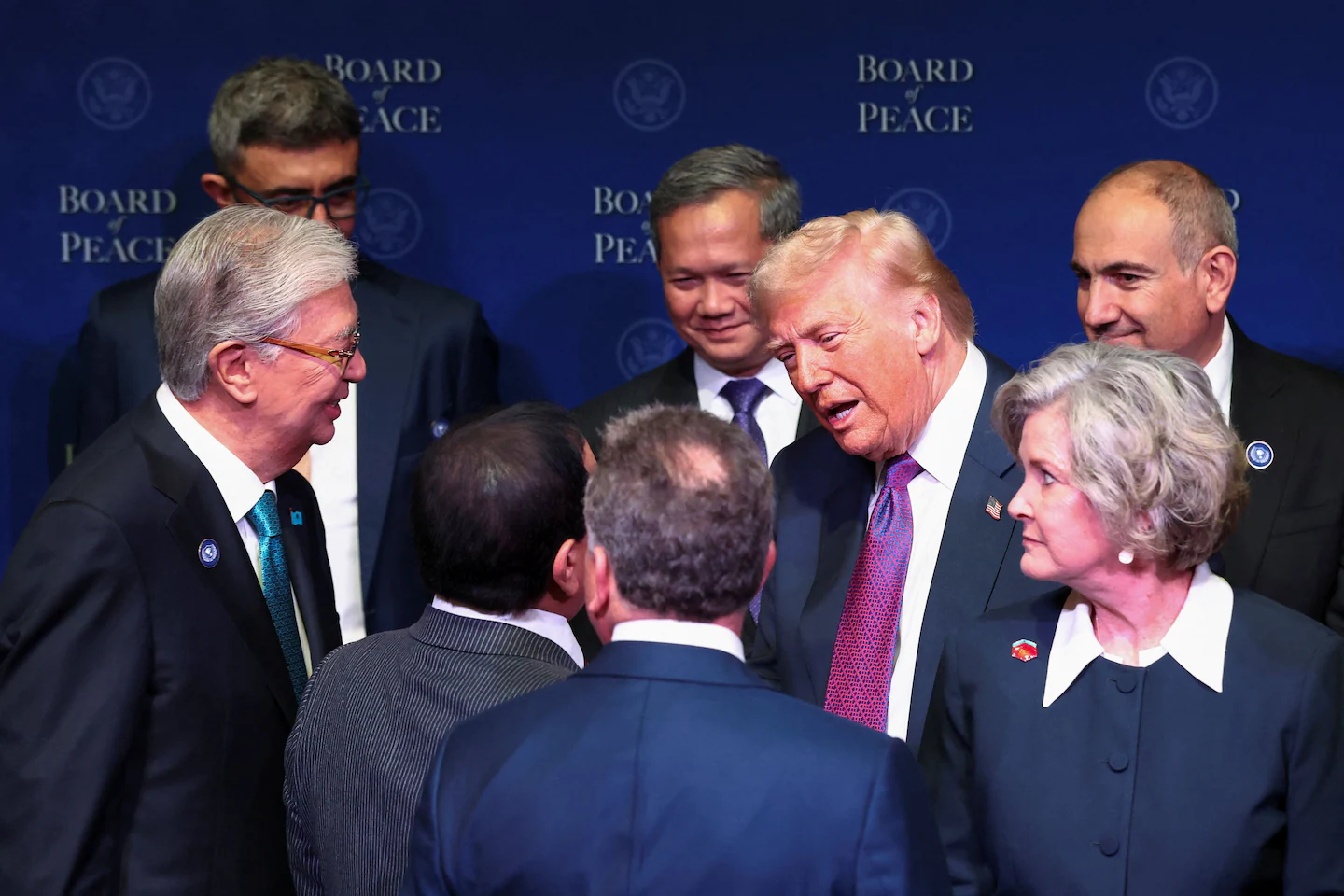
U.S. President Donald Trump has pledged a $10 billion contribution toward the reconstruction of Gaza as he convened the inaugural meeting of his newly created “Board of Peace,” an international body aimed at stabilising the war-torn territory.

Speaking at the meeting attended by representatives from about two dozen countries, Trump described the initiative as a major global platform for conflict resolution. “I believe it’s the most consequential board, certainly in terms of power and in terms of prestige,” he said.
The Board’s initial focus is the post-war recovery of Gaza following two years of conflict between Israel and Hamas. Participating nations, including several from Asia and the Middle East, pledged more than $6.5 billion in additional support, with the World Bank expected to manage the funds.
Officials at the meeting outlined plans for new local governance structures, a 5,000-member Palestinian police force, and the deployment of an international stabilisation force to support long-term security. The broader redevelopment blueprint also includes large-scale housing, infrastructure projects and proposals to transform parts of Gaza into a major economic and tourism hub.
Trump framed the Board as a supplement — and potentially an alternative — to the United Nations, which he criticised as ineffective. However, he did not clarify the source of the $10 billion pledge or whether congressional approval would be required.
Despite the ambitious plans, key challenges remain. There was limited discussion about the disarmament of Hamas, which still controls parts of Gaza — an issue Trump acknowledged, saying, “The world is now waiting on Hamas.”
The initiative has drawn mixed reactions internationally, with some U.S. allies participating only as observers and others expressing concerns about transparency, governance and the concentration of decision-making authority within the Board.
The reconstruction effort is expected to cost tens of billions of dollars, far exceeding the funds pledged so far, as Gaza continues to recover from widespread destruction and humanitarian strain.