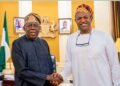
Former Vice President Atiku Abubakar has hinted at another presidential bid in the 2027 general elections amid ongoing debates over who will lead the emerging opposition coalition.

His latest comments come as discussions continue over the future of the alliance formed to challenge the ruling All Progressives Congress (APC).
Atiku, who contested and lost to former President Muhammadu Buhari in 2019 and President Bola Tinubu in 2023, made the remarks during a meeting with a delegation led by former Minister Idris Abdullahi. In a video shared on his official X handle, Atiku criticized corruption and promised to lead a government free of graft and mismanagement.
He emphasized that Nigeria’s progress had been stifled by a few individuals benefiting from bad governance.
According to him, the interim leadership of the coalition was carefully selected based on integrity and credibility—an indicator, he said, of the kind of leadership Nigerians could expect if the group takes power.
Atiku’s statement follows the unveiling of the African Democratic Congress (ADC) as the platform the opposition intends to use to contest the 2027 presidential election.
This coalition includes members from various parties and is seen as a potential alternative to the APC-led federal government.
However, internal disagreements over the presidential ticket have begun to surface. Senator Datti Baba-Ahmed, former Labour Party vice presidential candidate, recently expressed concern over the lack of a clear consensus candidate within the coalition.
Speaking on ARISE TV, he contrasted the current arrangement with the APC’s 2013 alliance, which had a unified focus on Muhammadu Buhari as the preferred presidential candidate from the onset.
He warned that the absence of a consensus choice could lead to a divisive primary election, possibly harming the coalition’s chances.
Baba-Ahmed also argued that Peter Obi, the Labour Party’s 2023 presidential candidate, should not accept a vice presidential role in 2027, citing his strong performance in the last election, where he polled over 10 million votes and won in two regions—South-East and South-South.
Meanwhile, Minister of Aviation and Aerospace Development, Festus Keyamo, dismissed the coalition as a political maneuver orchestrated by Atiku.
In a post on social media, he argued that the opposition group was essentially a faction of the People’s Democratic Party (PDP) under Atiku’s control, and claimed that Peter Obi was unlikely to secure the coalition’s presidential ticket.
Keyamo accused the coalition of attempting to exploit Obi’s popularity without offering him a leading role. He pointed to the appointment of former Senate President David Mark as interim chairman as further proof of Atiku’s dominance in the group.
As 2027 draws closer, the opposition’s path remains uncertain, with unity and leadership selection posing major hurdles.
Atiku’s renewed interest adds another layer to the political chessboard, while the rest of the coalition grapples with questions of trust, structure, and electoral strategy.