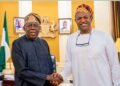


The Director-General of the Presidential Enabling Business Environment Council (PEBEC), Princess Zahrah Mustapha Audu, has called on Nigerian states to take full advantage of the $750 million State Action on Business Enabling Reforms (SABER) initiative to drive investment, job creation, and improve the ease of doing business.

Audu made the appeal on Wednesday during a technical session and town hall meeting with heads of investment-related ministries, departments, and agencies (MDAs), as well as other stakeholders in Osogbo, Osun State.
She emphasized that the SABER initiative jointly supported by the World Bank and the Federal Government is designed to incentivize and strengthen reforms across Nigeria’s subnational governments to foster business growth.
Speaking directly to the Osun State Government, Audu asked officials to explain the state’s non-participation in the SABER initiative and outline the steps taken to improve investment safety and attract investors.
While commending Governor Ademola Adeleke’s administration for implementing strategic reforms aligned with SABER’s goals, she stressed that “the state stands to gain significantly more by actively engaging with the initiative.”
“Even if a state is not participating in SABER, PEBEC remains a coordinating force for business reforms at the subnational level just like the CAC, NAFDAC, and other federal regulatory bodies,” she said.
Audu urged states to adopt data-driven strategies, including compiling federal investment incentives and tracking the number of entities benefiting annually, to boost investor confidence. She also encouraged transparency in licensing, renewal processes, and public access to investment information via dedicated websites.
During the technical session, stakeholders were reminded that even without accessing SABER loans, states must still implement reforms aligned with federal investment promotion guidelines.
In response, Osun State Commissioner for Economic Planning, Budget, and Development, Professor Moruf Ademola Adeleke, reiterated the state’s commitment to reform but explained its decision to avoid loan-backed programmes due to its ongoing efforts to reduce inherited debt.
“We are fully aligned with the investment mandate under SABER and have taken significant steps to improve the business climate,” he said.
He cited several ongoing reforms, including:
A streamlined process for issuing Certificates of Occupancy within 45 days.
Revitalization of the Osun State Investment Promotion Agency (OSIPA).
Digitized tax collection and operational transparency by the state internal revenue service.
A one-stop business registration centre at the Ministry of Commerce and Industry.
Road rehabilitation projects to boost access to markets and security.
Single-digit interest soft loans to small and medium enterprises (SMEs) via the Osun Micro-Credit Agency.
“These interventions reflect Osun’s commitment to enhancing the ease of doing business and attracting both local and foreign investment,” he added.
Officials at the meeting pledged continued alignment with federal reforms and reiterated the importance of collaborative efforts in advancing Nigeria’s economic development through business-friendly policies.