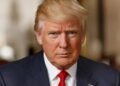
President Donald Trump on Monday ordered the deployment of 700 active-duty U.S. Marines and an additional 2,000 National Guard troops to Los Angeles, in response to escalating protests over immigration arrests. The president vowed that demonstrators would be “hit harder” than ever if unrest continued.

The military mobilization one of the most significant domestic deployments in recent U.S. history followed four days of protests sparked by dozens of immigration-related arrests in a city with one of the nation’s largest foreign-born and Latino populations.
In a post on X (formerly Twitter), California Governor Gavin Newsom sharply criticized the federal intervention, stating: “US Marines shouldn’t be deployed on American soil facing their own countrymen to fulfill the deranged fantasy of a dictatorial President. This is un-American.”
Protests turned chaotic Sunday night as demonstrators clashed with law enforcement in downtown Los Angeles, torching vehicles and looting businesses. Police responded with tear gas and rubber bullets.
However, Monday’s demonstrations were largely peaceful. Protesters voiced anger over the arrest of individuals authorities allege are undocumented migrants and gang members.
Outside a federal detention center, some demonstrators shouted, “Pigs go home!” at National Guardsmen, while others pounded on unmarked police vehicles. In contrast, some residents expressed support for the federal response.
“I think it’s needed to stop the vandalism,” said one small business owner, whose shop had been graffitied. She declined to give her name.
Others were appalled by the show of force.
“They’re meant to be protecting us, but instead, they’re like, being sent to attack us,” said Kelly Diemer, 47. “This is not a democracy anymore.”
In neighboring Santa Ana, approximately 32 miles southwest of Los Angeles, police used tear gas and flash-bang grenades to disperse crowds protesting against U.S. Immigration and Customs Enforcement (ICE).
Speaking in Washington, President Trump denounced the demonstrators as “professional agitators and insurrectionists.” He alleged on social media that protesters had spat at troops, warning: “If they continue, I promise you they will be hit harder than they have ever been hit before.”
Despite Trump’s rhetoric and isolated acts of violence, local officials emphasized that most protests had been peaceful. Schools remained open Monday and most areas of Los Angeles carried on with daily routines.
“This is isolated to a few streets. This is not citywide civil unrest,” said Los Angeles Mayor Karen Bass.
LAPD Chief Jim McDonnell acknowledged the challenge of coordinating with federal forces.
“The introduction of federal, military personnel without direct coordination creates logistical challenges and risks confusion during critical incidents,” he told reporters.
At least 56 individuals were arrested in Los Angeles over the weekend, and five officers sustained minor injuries, police said. Another 60 arrests were reported during parallel protests in San Francisco.
Demonstrations also flared in other cities. In Manhattan, an AFP reporter witnessed several arrests near a federal building where immigration hearings were underway. In Austin, Texas, NBC affiliate KXAN reported that police used tear gas to disperse demonstrators.
Legal experts raised concerns about the legality and implications of Trump’s actions.
Rachel VanLandingham, a professor at Southwestern Law School and a former U.S. Air Force lieutenant colonel, told AFP the move was “incredibly rare,” noting that the National Guard has not been deployed over the objection of a state governor since the civil rights era in 1965.
U.S. law generally prohibits the use of military personnel for domestic law enforcement except in cases of insurrection.
“For good reason,” VanLandingham said. “What does ‘protect’ mean to a heavily armed Marine??? Who has not/not trained with local law enforcement, hence creating a command and control nightmare?”
By late Monday, U.S. Northern Command reported that approximately 1,700 National Guard troops had taken positions across Los Angeles. The Pentagon confirmed that Trump had authorized an additional 2,000 guardsmen, on top of those already deployed.