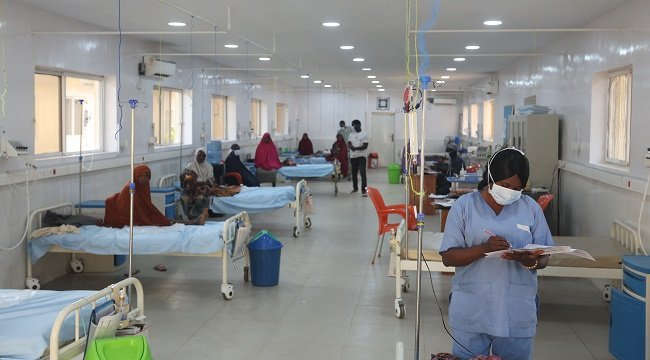
Vice President Kashim Shettima has called on African countries to strengthen their health systems and reduce reliance on foreign assistance by building self-sufficient and resilient healthcare sectors.

Shettima made the call on Friday at a high-level side event titled “Building Africa’s Health Security Sovereignty” held on the sidelines of the 39th African Union (AU) Summit in Addis Ababa, Ethiopia, where he represented President Bola Tinubu.
He said Nigeria is committed to continental collaboration, stating, “Nigeria stands ready to collaborate with every member state of our Union to make health security sovereignty measurable in factories commissioned, laboratories accredited, health workers trained, counterfeit markets dismantled, and insurance coverage expanded.”
Emphasising the need for collective action, the vice president added, “When history reflects on this generation of African leadership, may it record that when confronted with vulnerability, we chose capacity; when confronted with dependence, we chose dignity; and when confronted with uncertainty, we chose cooperation.”
Shettima warned that Africa’s dependence on external support leaves the continent vulnerable during global crises, recalling the COVID-19 pandemic when nations competed for limited vaccines, oxygen and medical supplies. He stressed that “health security is national security,” noting that disease threats and counterfeit medicines transcend borders.
Outlining Nigeria’s response, he said the Tinubu administration is prioritising local pharmaceutical production, increased domestic health financing and stronger regulation through initiatives such as the Nigeria Health Sector Renewal Investment Initiative and the Presidential Initiative to Unlock the Healthcare Value Chain.
According to him, the renewal initiative has secured over $2.2 billion in commitments aimed at revitalising more than 17,000 primary healthcare centres, training 120,000 frontline health workers and expanding insurance coverage within three years.
Shettima also noted that Nigeria is strengthening epidemic intelligence and emergency preparedness by expanding laboratory networks, enhancing genomic surveillance and improving coordination through the Nigeria Centre for Disease Control and Prevention (NCDC).
On regulatory reforms, he said the government is reinforcing oversight by the National Agency for Food and Drug Administration and Control (NAFDAC) through upgraded quality-control laboratories and stricter enforcement against substandard and falsified medicines.
The vice president reiterated that Africa’s long-term health security depends on building strong local capacity, financial protection and coordinated continental action to ensure the region can effectively respond to future health emergencies.