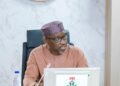
Governor of Nasarawa State Abdullahi Sule, expressed his support for the tax reforms introduced by President Bola Ahmed Tinubu, while emphasizing that Northern governors are primarily concerned with the exclusion of Value Added Tax (VAT) from the Federation Account Allocation Committee (FAAC).

Speaking at the formal launch of a new digital tax initiative by the Nasarawa State Board of Internal Revenue Services (NSBIRS) on Thursday at the Government House in Lafia, Governor Sule reiterated his endorsement of the broader tax reforms but clarified the Northern governors position on VAT.
“We are not against the tax reforms,” Sule stated.
“There are many positive aspects to the reforms that Mr. President is implementing.
However, our concern is specifically with the removal of VAT from the FAAC distribution.
We are asking for a review of this decision.”
The governor elaborated that removing VAT from FAAC would disproportionately affect Northern states, as it redirects significant revenue to the derivation formula, which favors oil-producing states.
He drew on his experience in the corporate world to highlight the challenges of implementing VAT at the point of consumption.
“Let me give you an example from my time as managing director of African Petroleum,” Sule explained.
“A customer in Maiduguri might order 200 trucks of goods, but only a fraction of them would actually be distributed in the region.
If VAT is charged based on consumption in Maiduguri, it would not accurately reflect the actual distribution, as most goods would be consumed elsewhere,” he said.
He continued, stressing that the complex nature of consumption-based VAT would make enforcement difficult.
“If VAT is based on derivation, the corporate headquarters in Lagos, where the VAT is collected, would be responsible, but this creates its own set of problems.
The whole system is prone to defaults,” he added.
The governor urged for a careful review of this particular aspect of the tax reforms to ensure fairness and avoid disadvantaging Northern states.
Governor Sule also commended the efforts of the Nasarawa State Internal Revenue Service, led by Executive Chairman Ahmed Yakubu Mohammed, for introducing a digital tax code designed to streamline revenue collection from the informal sector, which he described as a major challenge for tax collection.
“The informal sector is difficult to tap into, but it remains a critical source of revenue,” Sule acknowledged.
“This challenge is not unique to Nigeria or Nasarawa State, but globally.
We must leverage innovations like the USSD tax code to ensure better revenue collection from this sector,” Sule said.
Despite his support for improving tax collection, Governor Sule emphasized that true economic growth comes from productivity and manufacturing, not merely from tax increases.
“Taxes alone do not grow the economy,” he stated.
“We must focus on productivity, manufacturing, and other sectors.
However, it’s crucial to plug revenue leakages and ensure that collected taxes reach the right destinations,” he contined.
In conclusion, he encouraged local government officials to embrace the new digital tax code and ensure its proper implementation.
“I urge everyone involved in revenue collection to use this new system to its full potential.
The success of this initiative will benefit us all,” he concluded.