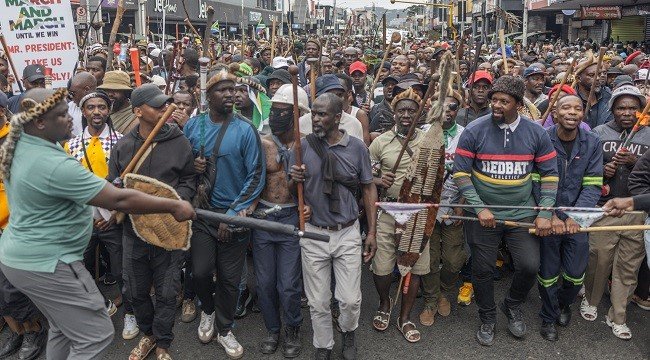
Nigeria and Ghana have agreed to strengthen bilateral cooperation to prevent the escalation of Afrophobic violence and protests across Africa, following recent attacks targeting African nationals in South Africa.
The agreement was reached during a meeting between Nigeria’s Minister of State for Foreign Affairs, Ambassador Sola Enikanolaiye, and Ghana’s Minister of Foreign Affairs, Samuel Okudzeto Ablakwa, on the sidelines of the ongoing ECOWAS Mid-Year Summit in Freetown, Sierra Leone.

According to a statement issued on Saturday by the spokesperson of Nigeria’s Ministry of Foreign Affairs, Kimiebi Ebienfa, both ministers emphasised the importance of closer collaboration and strategic consultations to address emerging tensions before they develop into full-scale crises.
Enikanolaiye stressed the need for preventive diplomacy, saying stronger engagement between both countries would help resolve potential flashpoints before they escalate.
The ministers expressed concern over the resurgence of Afrophobic sentiments and violence, warning that such developments threaten the ideals of African unity, regional integration, and the free movement of people as envisioned under the African Union’s Constitutive Act and the African Continental Free Trade Area (AfCFTA).
They jointly condemned the attacks, declaring that “all forms of xenophobia, Afrophobia, intolerance, and violence against fellow Africans” run contrary to the principles of Pan-Africanism and Africa’s collective development.
The two officials also called for coordinated regional and continental action to address the root causes of the tensions, safeguard the rights and dignity of African migrants, and promote peaceful coexistence across the continent.
While acknowledging that criminal offences committed by migrants should be handled through due legal process, they maintained that such cases must not justify mob violence or attacks against innocent and law-abiding African citizens.
To strengthen continental efforts, both ministers agreed to push for Afrophobia to be included on the agenda of the next African Union Summit. They also pledged to work with other member states to advocate stronger African Union mechanisms, including enhanced monitoring, early warning systems and preventive diplomacy to forestall similar incidents.
The meeting reaffirmed the longstanding ties between Nigeria and Ghana, with both countries urging African Union member states to recommit to the principles of Pan-Africanism, mutual respect and the free movement of persons, while promoting sustained public education and dialogue to combat prejudice.
Enikanolaiye also commended Ghana for its leadership in advancing Pan-Africanism and the campaign for reparations over the trans-Atlantic slave trade and colonial injustices.
He congratulated President John Dramani Mahama on the adoption of the landmark United Nations resolution on the Transatlantic Slave Trade and Ghana’s hosting of the Next Steps High-Level Conference on reparative justice.
He reaffirmed Nigeria’s support for the conference’s resolutions and the broader quest for reparative justice for Africans.
Responding, Ablakwa congratulated Enikanolaiye on his appointment and called for sustained cooperation between both countries. He endorsed a more action-oriented approach to preventive diplomacy, noting that it should be driven by “brotherly communications devoid of bureaucracy.”
The Ghanaian foreign minister also appreciated Nigeria’s backing for the UN resolution and acknowledged the country’s contributions to the global reparative justice campaign. He highlighted recent apologies from the Pope, the Church of England and the Church of Scotland, alongside ongoing efforts by several European countries to return looted artefacts and support restitution initiatives.
Ablakwa further conveyed his regards to Nigeria’s Minister of Foreign Affairs, Ambassador Bianca Odumegwu-Ojukwu, while commending the Nigerian delegation for its commitment to advancing reparative justice at the international forum.