

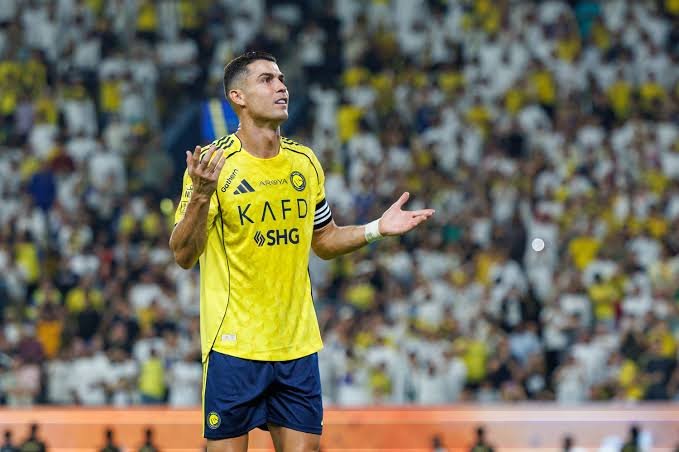
Cristiano Ronaldo has ended his brief strike at Al-Nassr and is set to return to the starting line-up this weekend, bringing a temporary resolution to a high-profile power struggle with the Saudi Pro League club, although his long-term future remains uncertain.

The 41-year-old forward had sat out Al-Nassr’s last two matches in protest over the club’s limited activity during the January transfer window. His refusal to play last week stunned club officials and underscored his frustration with Al-Nassr’s owners, the Saudi Arabian Public Investment Fund (PIF), over what he perceived as a lack of ambition in the transfer market.
Ronaldo watched closely as rivals Al-Ittihad secured Karim Benzema in a high-profile move, while Al-Nassr failed to reinforce their squad. His dissatisfaction was directed not only at the club, but also at the Saudi Pro League and PIF, all of which are closely linked.
As a result, Ronaldo missed matches against Al-Ittihad and Al-Riyadh. However, The Times reports that the Portuguese star has now made himself available for Saturday’s clash against Al-Fateh and is expected to feature for the remainder of the season.
The breakthrough followed Al-Nassr’s decision to address two key concerns raised by Ronaldo. Chief executive Jose Semedo and director of football Simão Coutinho — both close allies and Portuguese compatriots of the forward — have had their authority within the club reinstated, while outstanding wages owed to some club staff have also been paid.
Despite the short-term resolution, questions persist over Ronaldo’s future in Saudi Arabia. The former Real Madrid and Manchester United star is contracted to Al-Nassr until the end of next season, but a £43 million release clause is set to become active this summer.
Ronaldo has reportedly attracted interest from clubs in Europe and Major League Soccer, although his reported earnings of around £488,000 per day present a significant obstacle for teams without the financial backing of a sovereign wealth fund.
While Ronaldo appears to have emerged from the dispute in a stronger position, a statement issued last week by a Saudi Pro League spokesperson underlined the league’s stance on governance and decision-making.
“The [league] is structured around a simple principle: every club operates independently under the same rules,” the spokesperson said.
“Clubs have their own boards, their own executives and their own football leadership. Decisions on recruitment, spending and strategy sit with those clubs, within a financial framework designed to ensure sustainability and competitive balance. That framework applies equally across the league.
“Cristiano has been fully engaged with Al-Nassr since his arrival and has played an important role in the club’s growth and ambition. Like any elite competitor, he wants to win. But no individual — however significant — determines decisions beyond their own club.
“Recent transfer activity demonstrates that independence clearly. One club strengthened in a particular way. Another chose a different approach. Those were club decisions, taken within approved financial parameters.
“The competitiveness of the league speaks for itself. With only a few points separating the top four, the title race is very much alive. That level of balance reflects a system that is working as intended. The focus remains on football — on the pitch, where it belongs — and on maintaining a credible, competitive competition for players and fans.”