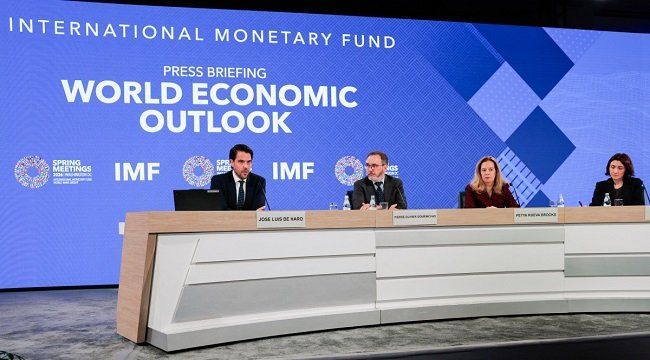
The International Monetary Fund (IMF) has projected that Nigeria’s debt-to-gross domestic product (GDP) ratio will rise to 33.1 per cent by 2027, according to its latest Fiscal Monitor Report.

The report, unveiled on Wednesday in Washington, D.C., during the ongoing IMF-World Bank Spring Meetings, indicates a gradual increase from 32.3 per cent projected for 2026. Nigeria’s debt-to-GDP ratio for 2025 was estimated at 35.3 per cent.
The IMF’s projection follows a request by President Bola Tinubu seeking National Assembly approval for external borrowing amounting to $6 billion.
Meanwhile, Nigeria’s public debt stock continues to climb. Data released by the Debt Management Office (DMO) shows that total public debt for federal and state governments rose to ₦159.27 trillion at the end of the fourth quarter of 2025.
The figure represents an increase of ₦5.98 trillion from ₦153.29 trillion recorded at the end of the third quarter and ₦14.6 trillion higher than the ₦144.67 trillion posted in the same period of 2024.
On the global outlook, the IMF noted that gross government debt rose to nearly 94 per cent of global GDP in 2025 and could reach 100 per cent by 2029, “a level previously reached only in the aftermath of World War II”.
“Global debt-at-risk three years ahead now stands near 117 percent of GDP, with a gap of roughly 20 percentage points between the median projection and the right tail, underscoring heightened downside risks. Several reinforcing forces could weigh on the fiscal outlook,” the Fund stated.
The IMF warned that geopolitical tensions, particularly conflict in the Middle East, could further strain government finances through higher food and fuel prices, tighter financial conditions, and increased defence spending.
It added that a prolonged conflict could push global debt-at-risk up by an additional four percentage points.
“Separately, a correction in artificial intelligence–related asset valuations, in which US stocks fall by 20 percent with spillovers to global financial conditions, could raise global debt-at-risk by a further 2.4 percentage points,” the report said.
Speaking to journalists, the IMF’s Director of Fiscal Affairs, Rodrigo Valdés, emphasised the importance of fiscal discipline.
“Crisis, of course, requires emergency support and people focus on the crisis, but the ability to respond really depends on pre-existing fiscal space, and too often, the needed consolidation is postponed,” he said.
“That only ratchets up squeezing the fiscal space for the next crisis.”
Valdés urged countries to make tangible progress in establishing credible medium-term fiscal frameworks and improving communication, warning that delays could lead to more difficult adjustments in the future.
“In low-income developing economies, a priority is to strengthen domestic revenue mobilisation to protect social and development spending, and also because we have to recognise that external aid is the gap with that,” he added.
He also cautioned against broad-based energy subsidies and discretionary fiscal stimulus, noting that such measures could complicate inflation control and weaken public finances.
“It would make just harder the central bank job in terms of inflation control,” Valdés said, warning that such policies are often “fiscally costly, regressive, and hard to unwind.”
The IMF stressed that with rising debt levels globally, fiscal responses must be carefully managed to avoid further strain on public finances.